Electronic press kit (EPK): what goes in it and how to build one
On a normal day a booker gets more band emails than they can read. Your subject line decides whether yours gets opened. What’s behind the link often decides whether it turns into a show: your EPK. As a manager I send EPKs and get them myself, and the good ones have one thing in common: within a minute you find the music, a live video, the numbers and a contact. Here’s what an EPK is, what goes in it and how to build one that actually gets read.
What an EPK is
EPK stands for electronic press kit. It bundles everything someone needs to make a decision about you or to write about you: who you are, what you sound like, what you look like live, what you’ve achieved and how to reach you. It used to be a folder with a CD, a photo and a press release. Today it’s a PDF, a page on your website, or both.
You need it wherever you pitch: to clubs and promoters, for festival slots and support shows, to press, blogs and radio, to labels, publishers and agencies. An EPK isn’t a résumé and it isn’t a fan page. It’s a working document for people who are short on time.
Who reads it and what they look for
Not everyone is looking for the same thing. That’s why a good EPK has a clear structure: everybody jumps to their part.
| Who | Looks at first | Wants to know |
|---|---|---|
| Booker, venue | Live video, genre, numbers in the region | Will people show up, and do you fit the program? |
| Festival | Live video, past shows, photos | Do you work on a big stage in front of people who don’t know you? |
| Press, radio | Short bio, current release, press photos | Is there a story, and can I run it without asking questions? |
| Label, agency | Music, how the numbers are developing, your team | Is this worth a conversation? |
| Production | Tech rider, stage plot, line-up | What am I dealing with on show day? |
That leads to the most important rule: the essentials go at the top. Someone who stops after page one should still know what you sound like and who to call.
The 8 building blocks
- Short bio: who you are, where you’re from, your genre, what’s coming up. Plus one sentence that sums you up.
- Music: two or three songs, strongest first. As streaming links, not attachments.
- Live video: one full song in a single take, with decent sound. For bookers this is often the most important part.
- Photos: high-resolution press photos in portrait and landscape, behind a download link and with a photo credit. Plus your logo.
- Numbers and highlights: honest numbers with a date, plus your three to six most important milestones.
- Press quotes: two to four short quotes with the source.
- Live: upcoming dates, past shows and a link to your tech rider and stage plot.
- Contact: booking, press and tech, each with a name, email and phone number.
How long it gets depends on where you are. A band starting out is fine with three or four pages, and a band with history rarely needs more than eight. Leave out what you don’t have. An empty “press quotes” page hurts more than no page at all.
Your bio in three lengths
The bio is the part that gets copied most: into show announcements, festival programs and articles. That’s why you need it in three lengths, in the third person, and written so it can be used without edits.
- One sentence: genre, where you’re from, what sets you apart. Example: “Alternative rock from Cologne: dark synths, big choruses, loud guitars.”
- Short bio, about 50 to 80 words: who, where from, what so far, what’s next. This is the text promoters paste into their announcement.
- Long bio, 150 to 250 words: the story behind it, for press and anyone who wants more.
Here’s what a short bio looks like, for the made-up band The Midnight Static:
The Midnight Static play alternative rock with dark synths and big choruses. The six-piece from Cologne has played more than 140 shows since 2019 and released two EPs. The single “Neon Ghosts” is out in 2027, followed by a club tour through Germany, Austria and Switzerland in April.
Three things don’t belong in any bio: superlatives nobody can check (“the most exciting band in town”), the complete band history since the first rehearsal room, and inside jokes. Write what happened, with years.
Music, video and photos
Music: two or three songs are enough. Put the strongest one first, not the newest. Link to Spotify, Apple Music, YouTube or Bandcamp and don’t attach MP3s to the email: big attachments end up in spam or never get downloaded. For unreleased songs, use a private link that plays without a login and without a download.
Video: a booker wants to see what happens on stage. That’s why a live video beats any music video: one full song in a single take, showing the band and the crowd, with decent sound. Leave out the phone clip from the front row with distorted audio. If you don’t have a good live video yet, getting one is the best investment before your next round of pitches.
Photos:
- Two to four press photos, at least one landscape and one portrait.
- High resolution behind a download link (300 dpi is the usual standard for print), with only small previews in the EPK itself.
- Add the photo credit and clear the photos for free editorial use beforehand.
- One photo with a calm background or empty space: promoters like to put the date and their logo on it.
- Your logo as a PNG with a transparent background, in light and dark.
Numbers and press quotes
Numbers aren’t mandatory, but they answer the question every booker has: will people show up? That’s why tickets sold say the most. “180 tickets in Cologne, January 2026” is worth more than a five-figure follower count. After that come monthly listeners, streams, newsletter subscribers and social media.
- Always add the date (“as of October 2026”) and update every few months.
- Only numbers that are true. Bought followers and inflated numbers get noticed, at the latest when someone looks at your likes or ticket sales.
- Small numbers are fine if they’re specific. “12 shows in 2026, 4 of them sold out (80 to 150 cap)” is a good line.
For press quotes: keep them short and name the source. Two to four quotes of one or two sentences each are enough. If there’s no press yet, leave the section out or use a quote from a promoter you’ve played for, with their permission.
10 mistakes that make sound engineers hate your stage plot
Most stage plots have at least three of them. Check yours in five minutes.
PDF, website or link?
| Format | Upside | Downside |
|---|---|---|
| Looks the same everywhere, easy to forward and file | Goes out of date quickly, video only works as a link | |
| Your website | Always up to date, music and video play right on the page | Needs a website you keep maintained |
| Folder link | Quick to set up (Drive, Dropbox) | Feels unfinished, links expire or need access approval |
My recommendation: both. An EPK page on your own website that’s always current, and the same content as a PDF for everyone who files documents. The link goes in the email.
- Keep the PDF under 10 MB, ideally under 5.
- File name with band name and year: Bandname_EPK_2026.pdf.
- Make the links in the PDF clickable and test every one after exporting.
- No password, no login, no “request access”.
The one-sheet
A one-sheet is the EPK condensed onto a single page: one photo, the short bio, the current release, three or four numbers, the next dates and a contact. It’s the page a booker forwards internally or a radio host keeps next to the microphone. If you only have time for one thing, start with the one-sheet and build the EPK around it later.
Sending your EPK
The best EPK is useless if the email never gets opened.
- A subject line that says something: band name, genre, reason, time frame. For example: “The Midnight Static (alternative rock, Cologne): support request, April 2027”.
- Keep it short: three to five sentences. Who you are, what you want, and why it fits this venue or festival.
- One link, not a pile of attachments: the link to your EPK and a link to the live video, right in the email.
- One clear question at the end: a date, a time frame or a specific slot.
- Follow up: once after 10 to 14 days, as a reply in the same thread, then one last note later on. Three emails are the limit.
Once a promoter is interested, the technical questions start. Have your tech rider and stage plot ready by then. Read how to write a tech rider, build your stage plot for free with the stage plot builder, and see what goes in a hospitality rider.
7 common mistakes
- No contact, or only a form: name, email and phone number belong on the first and on the last page.
- Too long: nobody reads twelve pages of band history. Cut until only what makes a decision easier is left.
- Out of date: last year’s tour dates and a singer who’s no longer in the band. Put a date on the EPK and check it every three months.
- Dead links: click every link after each export, on your phone too.
- Huge attachments: 40 MB of photos by email. Photos belong behind a download link.
- No live video: without one, a booker can only guess what you’re like on stage.
- Superlatives instead of facts: “unique sound” says nothing. Genre, comparable bands and numbers do.
Faster with a template
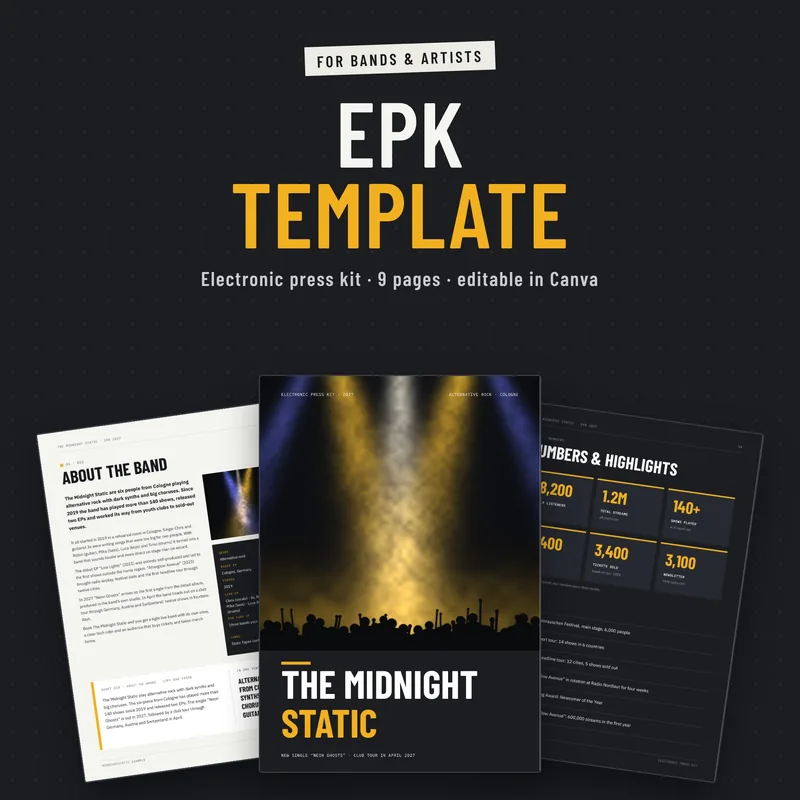
The Riderhouse EPK template is a Canva template with nine pages: cover, bio with short bio, music, numbers and highlights, press quotes, live, photos and downloads, contact and a one-sheet. It comes with a filled-in example, in A4 and US Letter. A free Canva account is enough.
If you want the emails to go with it: the Riderhouse Booking Kit bundles the EPK template, nine booking emails from the first show request to the follow-up, and a tracker that shows who to write to again and when.
EPK FAQ
What is an EPK?
An EPK (electronic press kit) is the digital press kit of a band or artist. It bundles bio, music, video, photos, numbers, press quotes, dates and contact details so bookers, festivals, press and labels can make a quick decision.
What should an EPK include?
Eight building blocks: short bio, music, live video, press photos, numbers and highlights, press quotes, live dates with tech info, and contact details. Leave out anything you don’t have yet.
How long should an EPK be?
As short as possible. Three or four pages are enough for a band starting out, and even with more history you rarely need more than eight. Add a one-sheet that sums up the essentials on a single page.
Should an EPK be a PDF or a website?
Ideally both: an EPK page on your own website that is always up to date, and the same content as a PDF under 10 MB for forwarding and filing. Put the link in the email instead of a large attachment.
Does a new band without press or big numbers need an EPK?
Yes, just a shorter one. A short bio, two songs, a live video, two good photos and a contact are enough for your first pitches. Add press quotes and numbers once you have them.
What is the difference between an EPK and a one-sheet?
The EPK is the full press kit with several pages. The one-sheet is the short version on one page with a photo, the short bio, the current release, key numbers, dates and a contact.
Do DJs need an EPK?
Yes. Instead of a line-up and a live video it shows a mix or a live set, residencies and the clubs and festivals you have played, plus your technical needs such as players and mixer.
Your EPK in one afternoon
Canva template with nine pages, a filled-in example and a one-sheet. A4 and US Letter.
Get the template