Split sheet: who wrote what? How to get songwriting splits in writing
The song is done, everyone’s buzzing, and nobody wants to talk about percentages right now. That’s exactly why it turns into an argument later: once the song is out, everyone remembers differently who wrote what. A split sheet gets the shares on paper in five minutes, ideally on the day of the session. Here’s what a split sheet is, what goes in it and how to split fairly.
What a split sheet is
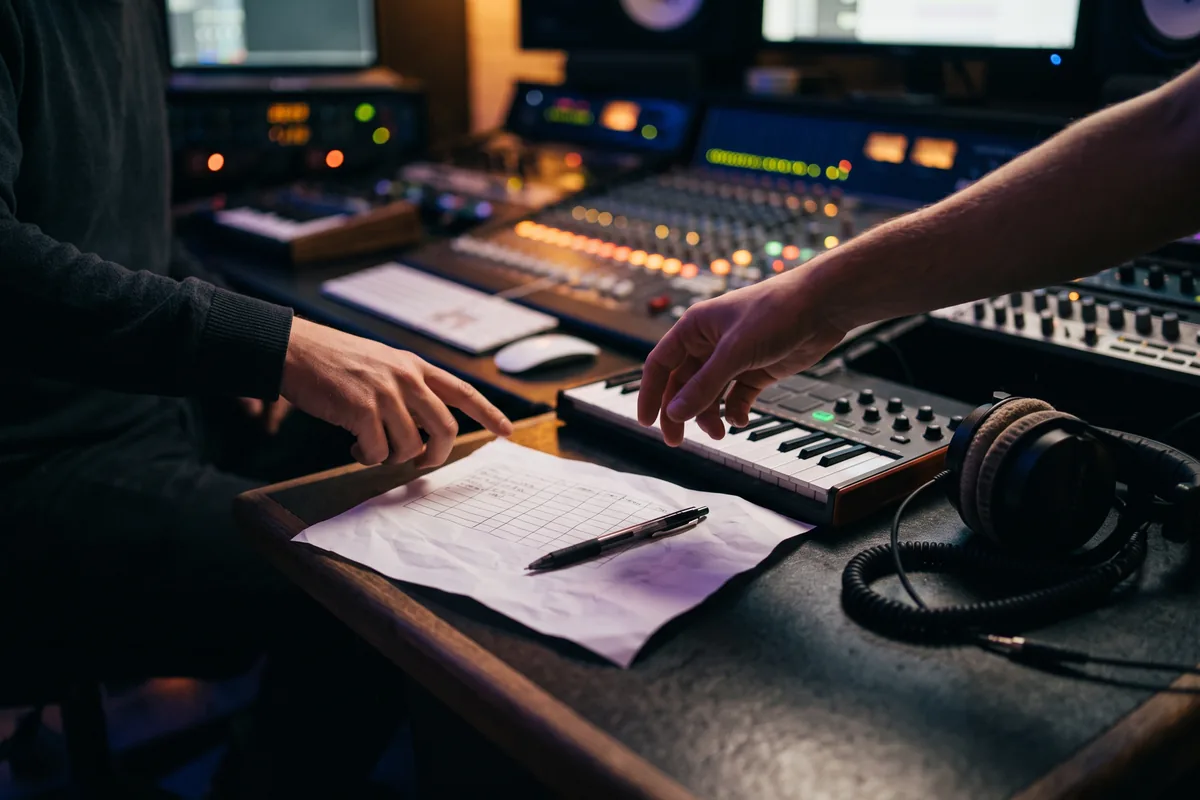
A split sheet is a short document in which everyone involved records who owns which share of a song. That means the composition: music and lyrics. Each person is listed with name, role and percentage, and everyone signs at the end. One sheet per song, that’s all it is.
You need it in three places: when registering the song with your PRO (ASCAP, BMI, PRS, SOCAN, GEMA), with your publisher, and as evidence if there’s ever a dispute. If two writers register the same song with different shares, that creates a conflict, and until it’s resolved the payout can be delayed.
Song and recording: two different rights
Every released song carries two different rights. Once you’ve got that, you’ll fill in the split sheet correctly.
The composition (music and lyrics) belongs to the writers. PROs and music publishers look after it. The recording (master) usually belongs to whoever paid for and organized it, often the label or the artist.
The split sheet covers the composition. Playing on or mixing the recording doesn’t automatically make you a writer. And a songwriter doesn’t automatically own part of the master. The recording has its own agreements, such as a producer or label agreement. If you do everything yourselves and have no such agreement, you can note the master split on the split sheet as well.
The 6 sections that belong in it
- Song details: final title, working title, date and place of the session, length, planned release. Don’t skip the working title, or a year from now nobody will know that “Rain idea 3” was the single.
- Writers and shares: per person the legal name, role (music, lyrics or both), share in percent, PRO, IPI number and publisher. The total has to be 100%.
- Contacts: email and phone for every writer. Sounds trivial, but it helps a lot when a publisher or a sync request needs to reach everyone years later.
- Recording / master (optional): only if you’re also splitting the rights in the recording and there’s no separate agreement for it.
- Agreement: the shares apply to all versions, edits and remixes. Everyone registers the song with exactly these shares. Changes only count in writing and with everyone’s consent. Samples are cleared separately.
- Signatures: everyone involved, with place and date.
Three abbreviations keep coming up. The IPI number is the international ID for songwriters and publishers. You get it when you join a PRO and can find it in your member account. The ISWC identifies the composition and is assigned after registration. The ISRC identifies a single recording and comes from your label or distributor. You can add ISWC and ISRC later.
Example: one song, three writers
Three people write a song in one session. One brings the lyrics and melody, two build the music, and one of those also produces the recording. This is what the most important section looks like:
| Name | Role | Share | PRO | Publisher |
|---|---|---|---|---|
| Chris Demo | lyrics, melody | 40% | ASCAP | self-published |
| Jo Sample | music | 30% | BMI | Example Music Publishing |
| Robin Test | music, production | 30% | PRS | – |
| Total | 100% |
All names are made up. In this example Robin also produces the recording. He doesn’t get a bigger share of the song for that, but 20% of the master instead of a fee. That goes separately in the optional recording section.
How do you split fairly?
There’s no rule that fits everyone. What matters is that everyone agrees. In practice you’ll see three models:
- Equal shares for everyone in the room: whoever wrote in the session gets the same. Quick, no bean counting, and common in many writing sessions.
- Music and lyrics separately: the classic approach is half for music and half for lyrics, shared within each half.
- By contribution: whoever contributed more gets more. Honest, but it invites discussion. It only works if you talk about it right after the session.
Then there are a few special cases:
- Producers and beats: whoever builds the beat or the instrumental foundation is co-writing the music and usually gets a share of the composition. Someone who records and mixes is typically paid a fee or a share of the master.
- Session musicians: normally play for a fee. Someone who comes up with a defining part may see that differently, so sort it out beforehand.
- Bands: many bands split everything equally, no matter whose idea it was. It keeps the peace. Others split song by song. Both work as long as it’s been said out loud and written down once.
- Samples: if you sample or interpolate someone else’s work, its rights holders will want a share. That comes out of your 100%. That’s why the split sheet should say whether the song contains samples.
Without an agreement the law decides in the end, and it differs by country. In the US, co-writers are generally treated as owning equal shares unless they agree otherwise. In Germany it depends on the extent of each person’s contribution, which you’d have to prove in a dispute. A signed sheet saves you that discussion.
When to fill it in and what happens next
On the day of the session. Everyone still remembers who contributed what, and nothing is at stake yet. If the mood doesn’t allow it, then at the latest before the song is registered or released.
- Fill it in: at the end of the session, printed or on a laptop.
- Sign: everyone involved. If someone joined remotely, send the PDF and have them confirm by email.
- Share: send a photo or PDF to everyone right away. Then everybody has a copy even if the original gets lost.
- Register: everyone registers the song with their PRO or publisher using exactly these shares.
- Keep it current: if a part, another writer or a sample is added, do a new split sheet with a new date, signed by everyone again.
10 mistakes that make sound engineers hate your stage plot
Most stage plots have at least three of them. Check yours in five minutes.
6 common mistakes
- Too late: weeks later everyone negotiates from memory, and usually the song is already out.
- The total isn’t 100%: happens faster than you’d think when someone is added afterwards.
- Stage names only: PROs work with legal names and IPI numbers. Add the stage name on top.
- Song and master mixed up: “everyone gets a quarter” doesn’t say of what. Write down composition and recording separately.
- Not everyone signed: the person who was “only there for a bit” is the one who gets in touch later.
- Changes not updated: the song gets rewritten, the old sheet stays. New version, new date.
Note: this article is not legal advice. A split sheet documents your agreement and does not replace a publishing, label or producer agreement.
Faster with a template
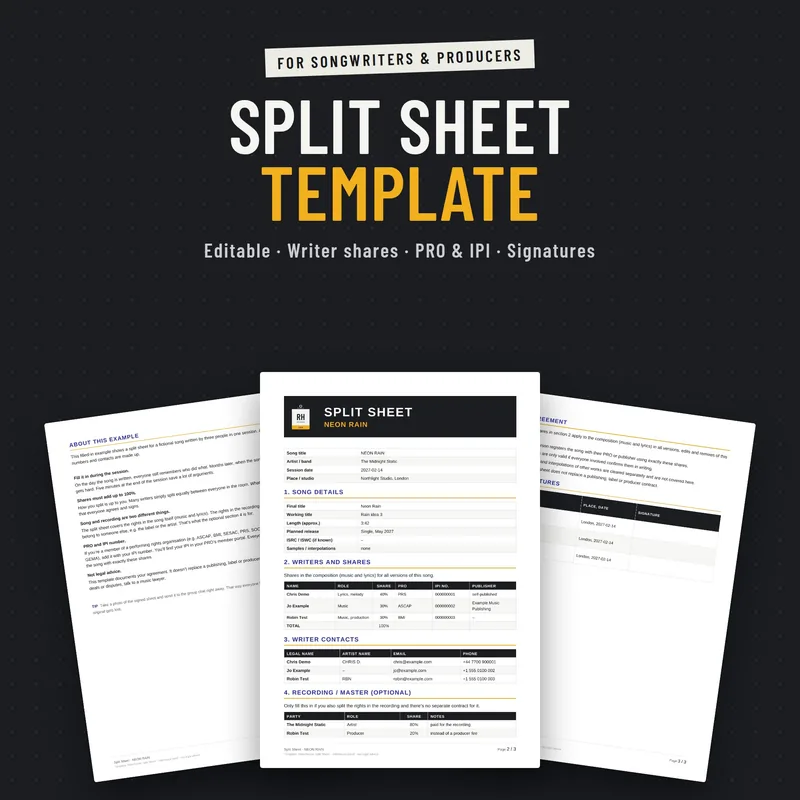
The Riderhouse Split Sheet is an editable template for Word and Google Docs plus a printable PDF for the studio: 6 sections, a filled-in example and an optional section for the recording.
Once the song is finished and heading for the stage: build your setlist for free with the setlist maker, your stage plot with the stage plot builder, and read how to write a tech rider to go with it. For the booking pitch you’ll need an EPK: see what goes in an electronic press kit.
Split sheet FAQ
What is a split sheet?
A split sheet is a short document in which all writers of a song record who owns which share of the composition (music and lyrics). Each person is listed with name, role, percentage, PRO and IPI number, and everyone signs at the end.
Is a split sheet legally binding?
It is a written agreement signed by everyone involved, which makes it strong evidence of what you agreed. It does not replace a publishing, label or producer agreement. For bigger deals or in a dispute, talk to a music lawyer.
When should you fill in a split sheet?
Ideally on the day of the session, while everyone still remembers who contributed what. At the latest before the song is registered with a PRO or released.
How do you split songwriting credits?
There is no fixed rule. Common approaches are equal shares for everyone who wrote, a split between music and lyrics, or shares by contribution. What matters is that the total is 100% and everyone agrees.
Does the producer get a share of the song?
If they co-write the music or lyrics, for example by building the beat or the instrumental foundation, usually yes. A producer who only records and mixes is typically paid a fee or a share of the recording (master), not of the composition.
Do I need a split sheet to register a song with ASCAP, BMI or PRS?
No PRO requires a split sheet. But when you register the work you enter the writers and their shares, and everyone’s registrations have to match. The split sheet makes sure you all register the same numbers.
Your split sheet in 5 minutes
Editable template with a filled-in example and a print version for the studio.
Get the template