How to write a tech rider engineers love: what goes in
As a backliner I’ve had hundreds of tech riders in my hands, from a two-page Word doc to a 40-page production manual. The good ones have one thing in common: the engineer on site understands what the band needs in two minutes. Here’s how to write a rider like that, what goes in and what to leave out.
What a tech rider is (and isn’t)
The tech rider (technical rider) describes what your band needs technically for the show: stage, layout, channels, monitoring, backline, power and lighting. It goes to the promoter and the house engineer, ideally together with the contract.
What doesn’t belong in it: food, drinks, hotel and guest list. That’s the hospitality rider. There’s a practical reason for splitting them: the engineer needs the channel list, the runner needs the drinks list. Neither wants to scroll through the other’s document.
The 10 building blocks of a tech rider
- Contacts: tour manager, FOH engineer, band. With phone numbers, not just email. Nobody calls an email address on show day.
- Line-up: who plays what, who sings, plus the size of the travelling party.
- Stage: minimum size (width × depth), risers, time needed for setup and soundcheck.
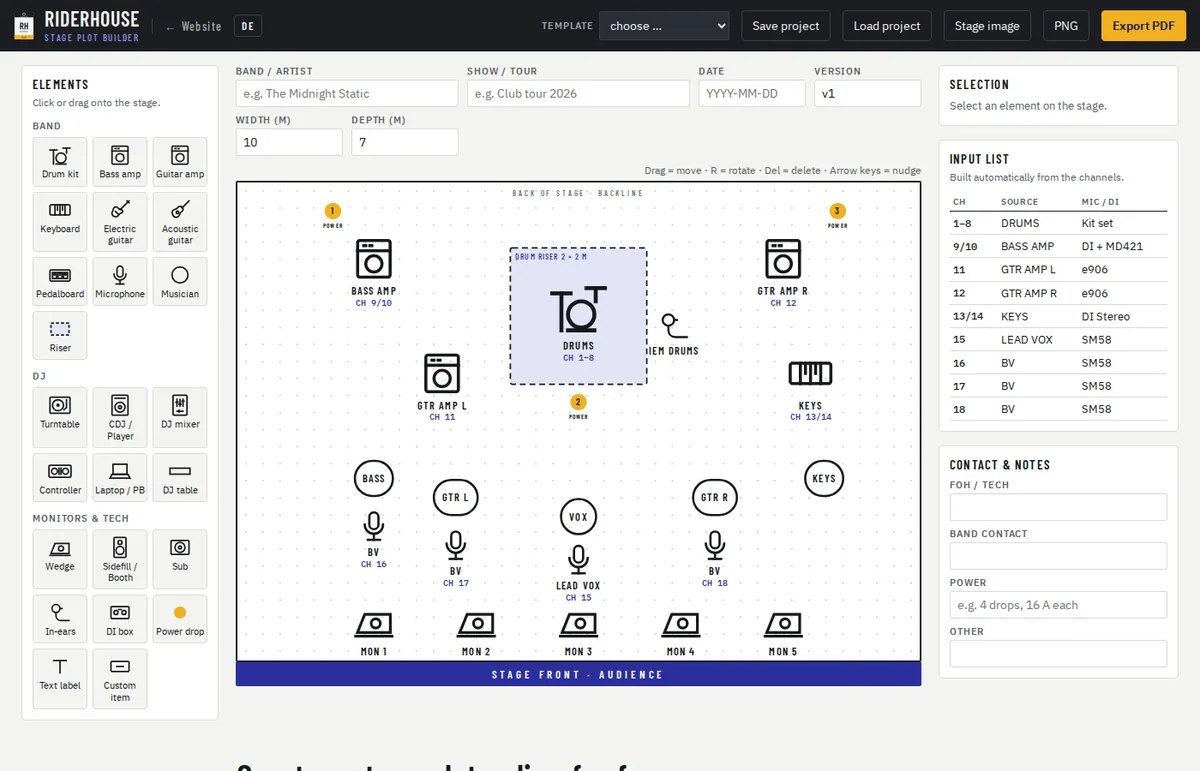
- Stage plot: the stage from above with instruments, amps, monitors and power drops. The most important picture in the whole rider.
- Input list: every channel with source, mic or DI and stand. More below.
- Monitoring: how many wedges or in-ear mixes, who wants to hear what. If you bring your own in-ears, say so here.
- PA and FOH: what the system needs to handle, where the desk should be, whether you bring your own engineer.
- Backline: what you bring and what should be provided. For fly-in shows often the whole drum kit.
- Power: where you need drops and how many. Ideally marked right on the stage plot.
- Lighting and schedule: lighting requests (e.g. no haze, strobe warning) and the planned running order, as far as it’s known.
Setting up your input list
The input list is the first thing the engineer transfers to the desk. It should match the stage plot exactly and always follow the same order: drums, bass, guitars, keys, playback, vocals.
| Ch | Source | Mic / DI | Stand |
|---|---|---|---|
| 1 | Kick In | Beta 91A | – |
| 2 | Kick Out | Beta 52A | short |
| 3 | Snare Top | SM57 | short |
| 9 | Bass | DI | – |
| 10 | Guitar L | e906 | – |
| 15 | Lead vocal | SM58 (band brings own) | tall boom |
Three rules that save you trouble: say which mics you bring yourself. Give alternatives (“SM57 or similar”) instead of insisting on one model. And update the list as soon as the line-up changes. Nothing wastes more soundcheck time than a channel list that doesn’t match the stage.
Tip: in the free stage plot builder you enter channel and mic right on the instrument and the input list builds itself.
Tech rider check: 7 mistakes engineers hate
The 7 most common mistakes with fixes, plus the 60-second check before sending and the 10 building blocks of a rider. Free PDF.
Faster with a template
You don’t have to start from scratch. With the stage plot builder you build your stage and input list for free in the browser and export them as a PDF or as an image for your rider.
For the complete rider there’s the Riderhouse Tech Rider Pro: an editable template for Word and Google Docs with 14 sections, a filled-in example and notes. The matching Hospitality Rider comes in the same design. What goes in it is covered in the hospitality rider guide. And before a promoter asks for your rider, they’ll want to see your EPK: what goes in an electronic press kit.
Tech rider FAQ
What is the difference between a tech rider and a hospitality rider?
The tech rider covers everything technical: stage, stage plot, input list, monitoring, PA, backline, power and lighting. The hospitality rider covers looking after the band: dressing room, drinks, food, allergies, hotel and guest list. Both are part of the performance contract and are usually sent together.
How long should a tech rider be?
As short as possible, as long as necessary. For a club band 3 to 6 pages is usually enough. What matters is that the stage plot and input list are easy to find, because that’s what the engineer looks at first.
When do you send the tech rider?
Ideally with the contract, or at least 14 days before the show, to the promoter and the house engineer. Festivals often need it earlier because several bands share one stage.
Does a tech rider need to be signed?
No, in practice that’s rare. Many riders still include an optional confirmation field. The rider becomes binding when the performance contract refers to it.
Can I make a tech rider for free?
Yes. You can build and export your stage plot including the input list with the free Riderhouse stage plot builder. The rest of the rider you can write yourself or use a ready-made template.
Start with your stage plot
Drag and drop your stage, add channels, and the input list builds itself. Free, no account needed.
Create a free stage plot