What is a DI box? Why you need one, active vs. passive and which to buy
If the bass hums, the keyboard is too quiet or the laptop hisses, the cause on stage is surprisingly often one small thing: the DI box. It’s tiny, unremarkable and in almost every tech rider. Here’s what it does, when you need an active or passive one, and which one is worth it for which instrument.

What a DI box does
DI stands for “direct injection”, feeding a signal straight into the desk. The box sits between instrument and stage box and does three things:
- It balances the signal. Instruments usually have unbalanced jack outputs. The DI turns that into a balanced XLR signal that arrives clean at the desk even over 30 or 50 metres of multicore.
- It matches the impedance. A bass pickup is high impedance; a desk input expects low impedance. Without a DI it sounds thin and loses top end.
- It breaks ground loops. With the ground lift switch, the typical hum disappears when instrument, amp and desk are on different circuits.
When you need one
| Source | DI needed? | Type |
|---|---|---|
| Bass | yes, often in addition to a mic on the amp | active for passive pickups, otherwise passive |
| Keyboard / synth | yes, two channels for stereo | passive |
| Laptop / playback | yes, because of hum via USB and power supply | passive, stereo or two channels |
| Acoustic guitar with piezo | yes | active |
| Drum pad / e-drums | yes | passive |
| DJ mixer | usually, if no balanced outputs | passive, stereo |
| Electric guitar | rarely, usually a mic on the amp | – |
Active or passive?
Passive DIs work with a transformer and need no power. They’re rugged, don’t hiss and handle high levels. Ideal for anything that comes out hot enough: keyboards, playback, drum pads, basses with active electronics.
Active DIs have their own electronics and need 48V phantom power from the desk or a battery. They’re the better choice for weak, high-impedance signals, i.e. basses with passive pickups and acoustic guitars with a piezo. There they bring out more low end and detail.
Rule of thumb from the road: when in doubt, use an active DI for bass and acoustic guitar and a passive one for everything else.
Ground lift, pad, thru: the switches explained
- Ground lift: disconnects the ground between instrument and desk. Only press it if there’s hum.
- Pad (-15 to -20 dB): lowers the level when the source is too hot, e.g. a keyboard at full volume.
- Thru / link: passes the original signal on, e.g. to the bass amp on stage. The bassist keeps their amp and the desk gets a clean DI signal.
- Speaker / amp input (on some models): lets you tap an amp’s speaker output. Only with DIs designed for it, otherwise the box gets damaged.
Tech rider check: 7 mistakes engineers hate
The 7 most common mistakes with fixes, plus the 60-second check before sending and the 10 building blocks of a rider. Free PDF.
How to connect it
- Instrument via jack into the DI’s input.
- If there’s an amp: from the thru output to the amp.
- From the XLR output to the stage box or desk.
- For an active DI switch on 48V at the desk; for a passive one leave it off.
- Pad off and ground lift off to start. If it hums, press ground lift. If it clips, engage the pad.
Picks: budget, mid-range, pro
Guide prices, they vary by retailer. The links go to the product on Amazon or to a search at Thomann.
Budget
| DI box | Type | Price | Best for |
|---|---|---|---|
| Behringer DI400P | passive | approx. €15–25 | For keys, playback and laptops with plenty of level. Small, no power needed, fine for the rehearsal room and lots of club shows. |
| Behringer DI100 | active | approx. €25–35 | Cheap way into active DIs, e.g. for bass with passive pickups. Runs on 48V or battery. |
Mid-range
| DI box | Type | Price | Best for |
|---|---|---|---|
| Radial ProDI | passive | approx. €80–110 | Rugged steel box, very common on tour. Good for keys, drum pads and playback. |
| Radial ProD2 | passive, stereo | approx. €130–170 | Two channels in one box: ideal for stereo keys or playback L/R. |
| Palmer PAN 01 | passive | approx. €40–60 | Solid passive DI with pad and ground lift, a lot of box for the money. |
Pro
| DI box | Type | Price | Best for |
|---|---|---|---|
| Radial J48 | active | approx. €180–230 | The standard active DI on big stages. Very low noise, great for bass and acoustic guitar. |
| Radial JDI | passive | approx. €180–230 | Passive pro DI with a Jensen transformer: warm, doesn’t distort at high level. |
| BSS AR-133 | active | approx. €250–320 | The classic in many rental stocks. Indestructible and sonically neutral. |
Links to shops may be affiliate links. If you buy through them, we get a small commission. The price stays the same for you. As an Amazon Associate I earn from qualifying purchases.
Tip for bands: two good passive DIs in your own case save a lot of hassle. Not every venue has enough, and nobody enjoys hunting for the last DI on show day.
DI boxes in your tech rider
In your input list, note for every channel whether a DI is needed, active or passive, and whether you bring it yourself. The engineer then knows in advance how many to prepare and whether 48V is needed. More in How to write a tech rider.
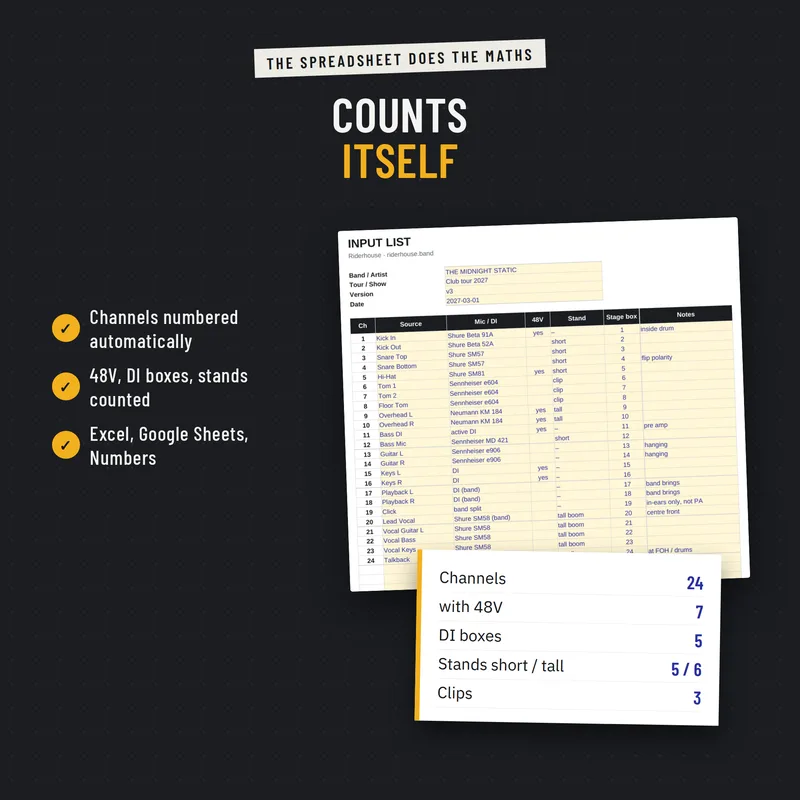
A ready-made template for this is the Riderhouse Input List for Word and Excel. The spreadsheet counts DI boxes, 48V channels and stands automatically. You can also enter channels right in the free stage plot builder.
DI box FAQ
What does a DI box do?
A DI box converts the unbalanced, high-impedance signal of an instrument (e.g. bass, keyboard, laptop) into a balanced, low-impedance signal that can travel over long cables to the mixing desk without interference. It also breaks ground loops and stops hum.
When do I need an active and when a passive DI box?
Passive DIs suit sources with plenty of level like keyboards, drum pads, playback and basses with active electronics. Active DIs are better for weak signals, like basses with passive pickups or acoustic guitars with a piezo. Active DIs need 48V phantom power or a battery.
What does ground lift on a DI box do?
The ground lift switch disconnects the ground between instrument and desk. That gets rid of hum caused by ground loops. Only press it if there is hum; otherwise leave it off.
What is the pad switch for?
The pad lowers the input level, usually by 15 to 20 dB. Use it with very hot sources, like keyboards or laptops at full volume or an amp’s speaker output, so the desk input doesn’t clip.
Does a laptop or keyboard need a DI box?
Almost always, yes. Keyboards, laptops and playback interfaces usually have unbalanced outputs. Through a DI box the signal runs balanced to the stage box, and hum from power supplies and USB can be fixed with ground lift. For stereo you need two channels or a stereo DI.
Get your DIs right in the rider
Input list for Word and Excel: counts channels, 48V, DI boxes and stands automatically.
Get the input list